
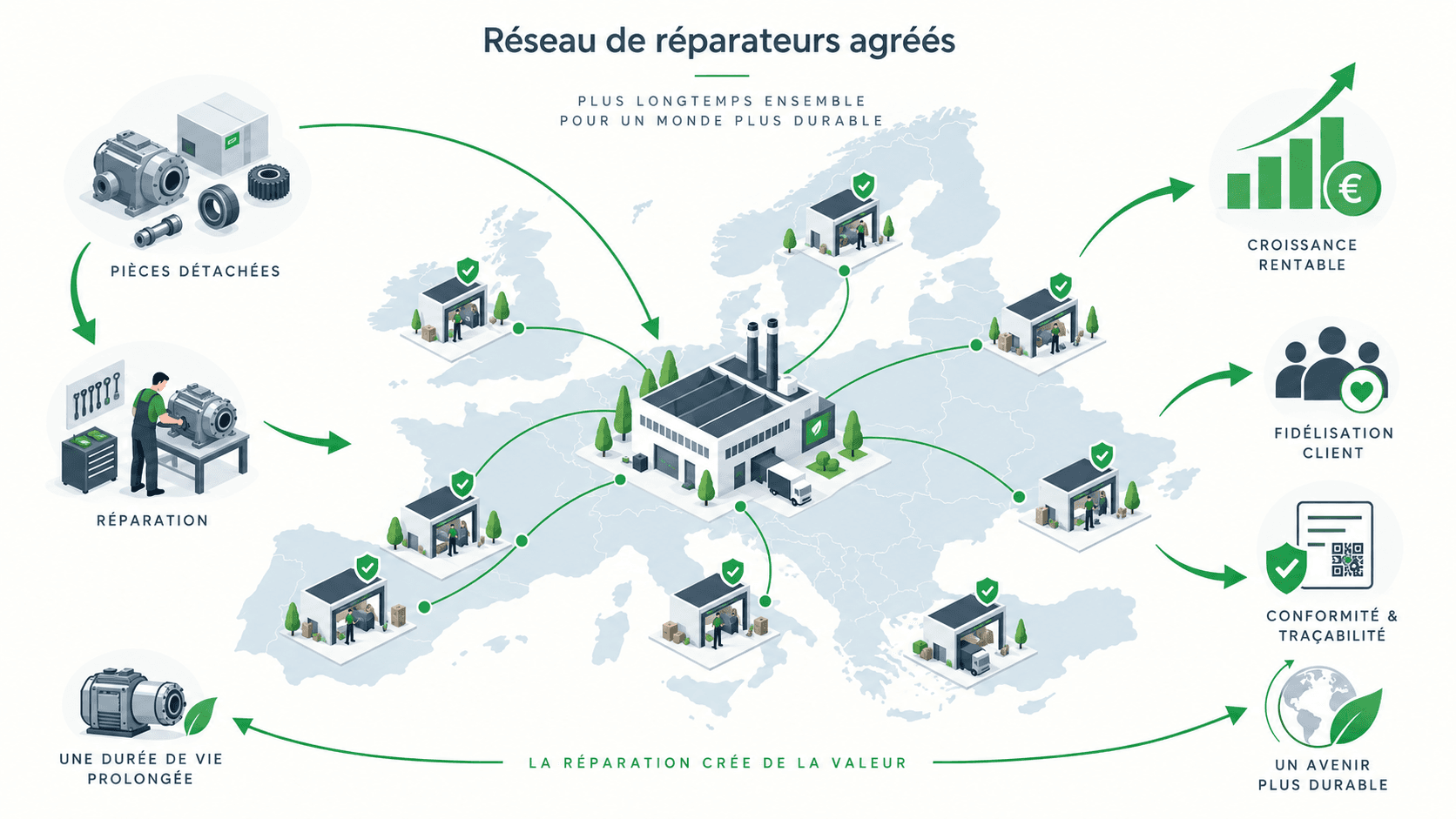
Introduction
Since 2024, the right to repair has become a cornerstone of ecological transition in Europe.
Retailers and brands must now orchestrate networks of authorized repairers to meet regulatory requirements and growing consumer expectations regarding sustainability and circular economy.
73% of French consumers say they prefer to repair rather than replace their products — a major opportunity for retailers who effectively structure their repair and refurbishment network.
Key market figure
The European repair market is expected to reach €12 billion by 2026. Retailers who anticipate this dynamic by structuring their network today capture a sustainable competitive advantage — in terms of legal compliance, customer loyalty and circularity.
What the right to repair concretely changes for retailers
European regulations impose new obligations on brands and retailers, which directly impact the organization of logistics flows, spare parts inventory management and intervention traceability:
- Access to spare parts: manufacturers must make essential components available for a minimum period after market launch
- Transparency and traceability: each repaired product must be documented, paving the way for the Digital Product Passport (DPP)
- Network of authorized repairers: retailers must reference and manage refurbishment workshops compliant with defined standards
- Consumer information: repairability index and take-back or second-hand options must be clearly communicated in-store and on digital platforms
Non-compliance risk
Retailers who fail to structure their repair network before regulatory deadlines face not only sanctions, but also a loss of consumer trust in a market where sustainability is becoming a determining purchase criterion.
The three strategic challenges of a well-structured repairer network
| Challenge | Impact for the retailer | Actionable lever |
|---|---|---|
| Regulatory compliance | Avoid sanctions, secure operations | Referencing of approved workshops, DPP traceability |
| Customer loyalty | Increase customer lifetime value (LTV) | Integrated repair, take-back and second-hand offers |
| Circularity & sustainability | Reduce carbon footprint, valorize products | Refurbishment flows, workshop return management |
Sustainable competitive advantage
Retailers who combine digital repair management platform, network of certified workshops and structured second-hand offering create a circular ecosystem difficult to replicate — and particularly valued by consumers committed to sustainable practices.
By structuring their network of authorized repairers today, retailers do more than respond to a legal constraint: they position their brand at the heart of the circular economy, transforming repair into a genuine lever for growth, differentiation and customer loyalty.
The Regulatory and Commercial Context
The repair services market is booming: repair services are expected to generate 12 billion euros in Europe by 2026, according to industry estimates.
At the same time, the European right to repair directive requires retailers and manufacturers to offer spare parts and reliable repair services for 5 to 10 years depending on product categories.
In practical terms, this means for each retailer:
- Setting up an approved repairer network covering the national territory
- Ensuring traceability and compliance of each intervention
- Guaranteeing competitive repair times (48 to 72 hours on average)
- Offering transparent and accessible diagnosis to the consumer
- Integrating obligations related to the Digital Product Passport (DPP) from the deployment phase onwards
Common pitfall: improvising the network
Many retailers think that letting customers find a repairer themselves is enough. That's wrong: without centralized orchestration, you lose quality control, customer data, and legal compliance.
A disorganized network = risk of fines + loss of customer trust.
The European directive leaves no room for approximation: traceability of each intervention is now an obligation, not an option.
What the directive concretely requires from retailers
The European right to repair directive is not limited to an obligation to make spare parts available. It structures a framework of operational requirements that directly affects the internal organization of retailers — their workshop, their stock logistics, their digital infrastructure.
Three obligations deserve particular attention:
- Availability of spare parts: manufacturers and distributors must guarantee access to essential parts throughout the legal lifespan of the product, at a reasonable price and within defined timeframes.
- Access to repair information: approved technicians must be able to access the diagrams, manuals, and software necessary for the intervention — a requirement that assumes a centralized documentary infrastructure and an adapted digital platform.
- Prohibition of practices hindering repair: restrictive contractual clauses, software locks, or deliberately non-repairable design are progressively regulated or prohibited.
Best practice: anticipate DPP compliance
The Digital Product Passport (DPP) is progressively establishing itself as the regulatory traceability standard. Integrating from today a digital tracking system by product — reconditioning, refurbishment, intervention history — puts you ahead of upcoming obligations and strengthens customer trust.
Product categories affected as a priority
The directive applies in successive waves depending on product categories. The first affected are:
| Category | Product examples | Duration of obligation |
|---|---|---|
| Home appliances | Washing machines, dishwashers, refrigerators | 5 to 10 years |
| Consumer electronics | Smartphones, tablets, laptops | 5 to 7 years |
| Display equipment | Televisions, monitors | 5 to 10 years |
For multi-department retailers, this means that several product ranges are simultaneously subject to different obligations.
This regulatory heterogeneity makes a centralized control platform all the more necessary, capable of managing variations in requirements by category, piloting repair flows, and guaranteeing compliance across both individual stores and the entire network.
Key takeaway: complexity that increases over time
As new categories enter the scope of the directive, the compliance burden increases mechanically. Retailers that structure their organization now — approved repairer network, digital traceability, centralized spare parts management — will be best positioned to absorb these successive regulatory waves without operational disruption.
Sanctions incurred in case of non-compliance
Non-compliance with the directive exposes retailers to administrative sanctions whose level varies depending on the Member State.
In France, control authorities can impose:
- Fines proportional to the retailer's turnover
- Compliance orders under constrained deadlines
- Precautionary measures that may affect the marketing of certain products
Beyond the direct financial risk, non-compliance generates a growing reputational risk.
Consumer associations and specialized media closely follow the implementation of these obligations. Failures are increasingly documented and publicly relayed — with a direct impact on customer trust and in-store performance.
Double exposure: financial and reputational
Do not underestimate the reputational aspect. In a context where the circular economy and sustainability are growing purchase criteria, a retailer flagged for non-compliance on the right to repair faces lasting damage to its brand image — far beyond the administrative fine.
Why Structure a Network Rather Than Improvise It
An approved repairer network is not just a list of contacts. It's a managed ecosystem where each repairer — internal, franchise, or third-party — respects your quality standards, your timelines, and your brand charter.
This structuring is not solely a response to regulatory constraints: it's a lever for operational performance and measurable retail differentiation.
The measurable benefits of a structured network:
| Indicator | Measured Performance |
|---|---|
| Customer satisfaction (in-brand repair) | +45 % |
| Reduction in operational costs | -30 % via technician scheduling optimization |
| Repair vs replacement rate | +60 % (direct circular impact) |
| Legal compliance | Right to repair + ISO standards guaranteed |
| Circular revenue (repair + second-hand) | +35 % on average |
The orchestrated repair platform enables precisely this centralized management: remote AI diagnosis, intelligent allocation to repairers, real-time tracking, and automated compliance.
Best practice: integrate the platform during the network deployment phase
The earlier the digital platform is integrated into the repairer approval process, the faster you achieve a level of traceability compliant with the Digital Product Passport (DPP) — and the faster you reduce your field coordination costs.
The Three Network Organization Models
Retailers have three main architectures available to structure their network, each with its own trade-offs in terms of control, cost, and territorial coverage.
| Model | Description | Advantages | Limitations |
|---|---|---|---|
| Internalized network | Salaried technicians or in-house workshops | Maximum quality control, brand consistency | High fixed costs, limited geographic coverage |
| Approved partner network | Certified independent or franchised repairers | Rapid national coverage, flexibility | Requires rigorous approval protocols and continuous monitoring |
| Hybrid model | In-house workshops + peripheral partner network | Optimizes costs and service quality | More complex coordination between the two flows |
The dominant model among national retailers
The hybrid model is most common among national-scale retailers: it combines in-house workshops for dense areas and high-value products, with an approved partner network to ensure peripheral coverage. It's the best balance between cost control and service level.
Approval Criteria to Define Before Deployment
A repairer's approval cannot rest solely on administrative verification. Operational criteria are equally decisive in guaranteeing network consistency and the sustainability of the reconditioning ecosystem.
The structuring approval criteria to validate:
- ✅ Technical certification on the product ranges concerned
- ✅ Ability to meet contractual timelines (48 to 72 hours)
- ✅ Equipment with diagnostic tools compatible with the central platform
- ✅ Acceptance of traceability protocols imposed by the Digital Product Passport (DPP)
Legal risk: do not neglect approval documentation
A poorly documented approval process exposes the retailer in case of dispute or regulatory inspection. A complete approval file — based on objective and verifiable criteria — constitutes formal proof that the network was established in accordance with the rules. It is essential protection against the growing requirements of the right to repair.
Continuous Network Performance Management
Building the network is only the first step. Maintaining quality over time requires an active management system structured around four levers:
- 📊 Performance dashboards by repairer and geographic area
- ⏱️ Automatic alerts on missed deadlines or non-compliant interventions
- 💬 Post-intervention satisfaction surveys measured in real-time
- 🔍 Periodic on-site audits to verify workshop compliance and practices
The priority indicators to monitor continuously:
| KPI | Why It's Critical |
|---|---|
| First-time intervention success rate | Measures resolution without return — key indicator of technical quality |
| Average response time | Directly impacts customer satisfaction and contractual compliance |
| Customer satisfaction rate (real-time) | Allows quick identification of weak links in the network |
| DPP documentary compliance rate | Guarantees product traceability and regulatory compliance |
This data allows you to quickly identify weak links in the network and take corrective action before they affect legal compliance, second-hand logistics flows, or in-store customer satisfaction.
Automate management to gain responsiveness
Digital network management platforms enable real-time collection of these KPIs. Less manual coordination, fewer blind spots in monitoring — and the ability to manage a national repairer network with the same standards as an in-house workshop.
The Key Role of Remote Diagnostics
Before engaging a repair technician, the problem must be qualified. This is where intelligent diagnostics come in: 62% of repair requests can be resolved through AI diagnostics, without any physical intervention.
This accelerates the process, reduces costs, and significantly improves customer satisfaction — while freeing up field technicians for cases that truly require their expertise.
A strong network of authorized repair partners therefore relies on a coherent technical stack:
- A high-performance AI diagnostic system (video, photos, voice description)
- Automated scheduling of technicians in-store and on-site
- Complete traceability of each intervention (DPP compliance — Digital Product Passport)
- Smooth escalation to specialized repair partners if diagnostics reveal technical complexity
Key Point: repair as a strategic lever
Repair is no longer an operational burden: it's a lever for customer loyalty, legal compliance, and circularity.
Structuring your network of authorized repair partners means investing in sustainability and profitability simultaneously — two objectives that, in the circular economy, reinforce each other.
How AI Diagnostics Works in Practice
Remote diagnostics relies on a combination of multimodal input channels. The customer submits a text description, photos, or a short video of the malfunction via a web or mobile interface.
The AI engine analyzes this data by cross-referencing it with the product knowledge base:
- History of failures recorded across the installed base
- Technical diagrams and manufacturer documentation
- Feedback from technicians based on past interventions
The system then produces a problem qualification and a clear action recommendation, immediately directing toward the right resource — human or automated.
Two Resolution Scenarios
Simple case — user error, incorrect settings, software update needed: resolution is guided directly in the interface, with no physical intervention or travel required.
Complex case — confirmed hardware failure: diagnostics automatically generate a pre-filled work order, sent to the most suitable repair partner based on location, certifications, and availability in the schedule.
| Request Type | Processing | Result |
|---|---|---|
| User error / incorrect settings | Guided self-service resolution | 0 travel, immediate resolution |
| Software update needed | Automated procedure in interface | 0 technician mobilized |
| Simple hardware failure | Work order to local technician | Targeted intervention, first-visit resolution |
| Complex failure / multi-component | Escalation to certified specialist | Appropriate expertise, DPP traceability assured |
Impact on Field Technician Workload
Upstream filtering through AI diagnostics structurally changes the nature of interventions reaching technicians. By eliminating false positives — requests that could have been resolved without travel — the system concentrates technician activity on cases with genuine technical value-add.
Concretely, this optimization of intervention flows translates to:
- Better utilization of technician time: fewer unnecessary trips, more complex cases handled
- Reduction in non-productive travel: direct impact on logistics costs and carbon footprint
- Improved first-visit resolution rate: the technician arrives with a pre-qualified diagnosis and appropriate parts
Profitability of Partner Repair Shops
For partner repair shops paid per intervention, this optimization also improves their own profitability — which strengthens their commitment and loyalty to the network. A high-performing repair network is one where partners have an incentive to stay.
Integrating Diagnostics into the Customer Journey
Remote diagnostics is not just an operational tool: it's also a customer touchpoint with high stakes. A smooth, fast, and transparent diagnostic journey directly contributes to the retail brand's perceived service quality.
Retailers that integrate diagnostics into their mobile app or online customer portal create a natural entry point for the entire after-sales journey:
- Repair at authorized workshop or on-site
- Warranty management and warranty extension
- Trade-in or exchange in a second-hand and reuse logic
- Intervention tracking with complete traceability (Digital Product Passport compliance)
Don't Neglect the Diagnostic Experience
A poorly designed diagnostic journey — too long, unintuitive, with no clear feedback — transforms an already negative moment (the breakdown) into a customer relationship breaking point. Investment in the diagnostic platform's UX is as strategic as investment in the repair network itself.
This integration transforms a moment of friction (the breakdown) into an opportunity to strengthen the customer relationship — and potentially activate new circular services: replacement rental, reconditioning, refurbishment for second-hand resale. Diagnostics thus becomes the gateway to an ecosystem of high-value-add services, serving both sustainability and profitability.
The link between second-hand and global sustainability
A well-structured repair network doesn't stop at product restoration. It creates a virtuous cycle that directly feeds second-hand and refurbishment channels.
This circular dynamic unfolds in four stages:
Repaired products → Durable products → Access to quality second-hand (REUSE) → Reduction of global carbon footprint
Retailers that combine repair and resale of refurbished products increase their circular revenue by an average of 35% — concrete proof that the circular economy is also a profitable economy.
Circular economy: repair as an entry point
Repair is often the first link in a complete circular strategy. It determines:
- The quality of products entering the second-hand channel
- The accuracy of data in the Digital Product Passport (DPP)
- The retailer's capacity to valorize its product assets over the long term
Repair → Reuse → DPP Traceability → Measurable circularity.
Repair as a condition for second-hand quality
The quality of a refurbished product depends directly on the rigor with which it has been diagnosed and repaired.
A network of authorized repairers, operating according to standardized and documented protocols, produces reliable intervention data. This data allows precise qualification of the product's condition before resale on the second-hand market.
This traceability is a direct commercial argument: buyers of refurbished products are increasingly attentive to intervention history and associated certifications.
DPP valorization: a measurable competitive advantage
A product whose repair is documented in the Digital Product Passport (DPP) commands a better price than a product without verifiable history.
- ✅ Complete and timestamped intervention history
- ✅ Certification from authorized repair workshop
- ✅ Traceability of spare parts used
- ✅ Precise qualification of refurbishment grade
Traceability is not just a regulatory requirement — it's a pricing lever on the reuse market.
Contributing to carbon footprint reduction
Each repair performed — that is, each replacement avoided — represents a measurable carbon saving.
Sector studies estimate that repairing a smartphone generates on average 70% fewer CO₂ emissions than manufacturing an equivalent new device. A considerable gap that translates directly into retailers' sustainability indicators.
For retailers subject to carbon footprint reduction targets under their extra-financial reporting obligations (CSRD), the repair network becomes a quantifiable environmental performance lever.
Data from the management platform enables:
- Precise calculation of emissions avoided per period
- Integration of these indicators into CSRD sustainability reports
- Demonstration of impact of repair policy to stakeholders
- Comparison of performance between workshops, regions, or product types
Repair and CSRD: a strategic synergy
Extra-financial reporting obligations (CSRD) transform the repair network into a compliance asset. Each intervention documented in the digital platform becomes exploitable data for sustainability reports — without additional administrative burden for retail teams.
Building a coherent circular offering around repair
Repair generates its full strategic value only when integrated into a coherent circular offering.
This requires systematically connecting flows between three operational levels:
| Flow | Source | Destination | Value created |
|---|---|---|---|
| Unretrieved repaired products | Repair workshop | Second-hand stock | Circular revenue |
| Intervention data | Management platform | Digital Product Passport (DPP) | Product traceability and valorization |
| Recovered spare parts | Refit operations | Refurbishment channel | Reduction in supply costs |
| Trade-in products | Store / collection point | Refurbishment flow | Reuse stock supply |
Retailers that build this operational coherence between repair, refurbishment, and resale create an autonomous circular business model.
This model presents two major structural advantages:
- Lower dependence on new product flows and supply chain tensions
- Greater resilience to market variations through stock source diversification
Operational circularity: where to start?
For retailers wishing to build a coherent circular offering, the recommended sequence is:
- Structure the repair network with standardized protocols and a digital management platform
- Connect logistics flows between the workshop, second-hand stock, and refurbishment channel
- Activate the DPP to automatically enrich product history with each intervention
- Measure and manage circular indicators (emissions avoided, reuse rate, circular revenue)
Each step strengthens the next — repair is the entry point, measurable circularity is the objective.
Key takeaways before moving forward
Retailers that fail to anticipate structuring their repair network face a triple risk:
- Regulatory risk: non-compliance with the European right-to-repair directive
- Commercial risk: loss of market share to retailers offering a smooth, traceable repair experience
- Operational risk: lack of reliable data to feed the Digital Product Passport (DPP) and refurbishment channels
Network structuring is not optional — it's the foundation of any sustainable and compliant retail strategy.
Want to go from theory to practice? Discover the Repair by ZIQY platform.
Request a demo →