
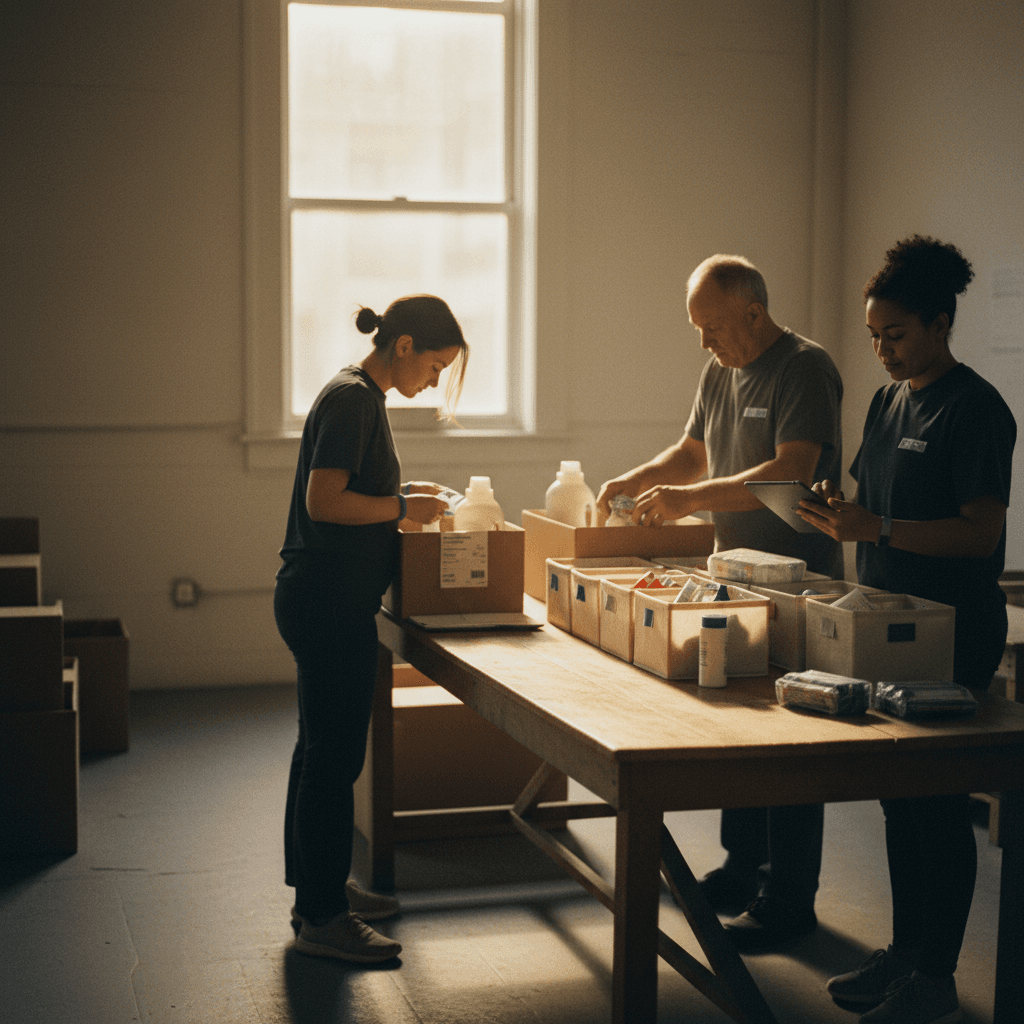
Replenishment: The Winning Model for Smart Consumption
Laundry detergent, diapers, razors, tampons: these everyday products aren't the most exciting to buy. Yet, they are essential.
And above all, they represent a recurring expense for most households. It is in this context that automatic replenishment emerges as a logical, efficient, and increasingly popular model.
Definition — Replenishment
Replenishment consists of automating orders for consumable products.
The user no longer places an order each month: they automatically receive what they need, at the right time, without domestic stock shortages.
This model profoundly transforms the way we consume. It directly addresses new customer expectations in terms of simplicity, budget control, and logistical convenience.
It also aligns with the evolution toward a smarter and more responsible circular economy — where each order is optimized, overstocking is avoided, and packaging is rationalized.
Why This Topic Matters for Retailers?
Automatic replenishment is no longer just a competitive advantage: it's a lever for structural customer loyalty. Retailers that integrate this model into their omnichannel strategy see a significant increase in customer lifetime value (LTV) and a reduction in churn rates for everyday products.
| Purchase Model | Order Frequency | Risk of Stockout | Customer Engagement |
|---|---|---|---|
| Classic one-time purchase | On demand | High | Low |
| Subscription / automatic replenishment | Scheduled & regular | Nearly zero | Strong |
| Buyback & second-hand | Occasional | Variable | Moderate |
This guide explores the mechanisms, benefits, and conditions for success of automatic replenishment — for consumers as well as for retail and logistics players.
New Consumer Expectations
Over the past few years, we have observed a profound shift in consumption habits. The public no longer wants to buy for the sake of buying.
They seek to optimize their purchases: less waste, greater relevance, and above all more convenience. This transformation affects both physical channels (stores, omnichannel retail) and digital platforms.
Automatic replenishment perfectly aligns with this underlying trend, responding to concrete and measurable needs.
What consumers are concretely looking for
Replenishment addresses several essential needs that have now become basic expectations:
- Time savings: no need to remember to reorder — the platform manages the cycle on behalf of the customer
- Security: avoiding stock-outs and shortages that generate frustration and loss of trust
- Personalization: the offer adjusts dynamically to the customer's habits and consumption frequency
- Simplicity: digital interfaces are intuitive, customizable, and accessible from any channel
💡 Consumer Insight
Customers want a smoother daily life, free from unnecessary constraints. This is exactly what replenishment offers by transforming recurring purchases into automated service — a logic similar to subscriptions, without contractual rigidities.
Smart consumption vs traditional consumption
This evolution is part of a broader approach to smart consumption, where efficiency takes precedence over accumulation. The table below illustrates this paradigm shift:
| Criterion | Traditional consumption | Smart consumption (replenishment) |
|---|---|---|
| Purchase trigger | Observed stock-out, impulse | Automated anticipation |
| Consumer effort | High (search, manual ordering) | Minimal (initial setup) |
| Stock management | Reactive, often out of stock | Proactive, optimized logistics flow |
| Personalization | Limited, generic | Adapted to actual habits |
| Environmental impact | Superfluous purchases, waste | Circular economy, less overconsumption |
| Channel | Primarily in-store | Omnichannel, digital-first |
📊 Underlying Trend
The replenishment model naturally aligns with circular economy principles: buy right, at the right time, in the right quantity. It reduces impulse purchases, limits unsold inventory on the retail side, and optimizes the supply chain end-to-end.
A structural change, not a passing fad
This evolution is not limited to a trend effect. It reflects a structural shift in the relationship between consumers and brands.
Digital platforms that integrate replenishment mechanics — whether recurring subscriptions, second-hand resale, or automated stock management — respond to a fundamental demand: simplifying daily life without sacrificing the quality or relevance of the offering.
⚠️ Alert for retailers
Failing to offer a replenishment or subscription solution risks losing your most loyal customers to more agile digital platforms. Logistics and omnichannel experience are now selection criteria just as much as price.
This dynamic places smart consumption at the heart of modern retail strategies, where efficiency definitively takes precedence over accumulation.
Why Reordering is Strategic for Brands
From the brands' perspective, the advantages are numerous and measurable. The subscription model linked to reordering makes it possible to transform a one-off transactional relationship into a lasting partnership with the customer — with benefits that are visible both in the revenue line and in the operational maturity of the company.
Direct Economic Advantages
Automated reordering, backed by a subscription model, generates immediate and quantifiable financial effects:
- Secure recurring and predictable revenues, independent of seasonal fluctuations
- Build long-term customer loyalty, by reducing churn rate and acquisition cost
- Improve sales forecasting thanks to usage data collected continuously on the platform
💡 Underestimated Financial Lever
The revenue predictability linked to the subscription allows brands to optimize their production cycles and reduce costly overstock — a central logistics challenge in high-turnover sectors.
Strategic Advantages
Beyond the immediate financial impact, reordering creates structural competitive advantages that strengthen the brand's position in its ecosystem:
- Analyze customer behavior continuously, to refine the offering and personalize the omnichannel experience
- Optimize inventory management and reduce logistics costs through better demand anticipation
- Create a barrier to entry against competition, by anchoring the brand in consumption habits
📊 Data & Governance
Usage data collected via a subscription model makes it possible to feed demand forecasting algorithms that are far more accurate than traditional sales histories — a decisive advantage for real-time inventory management.
Comparison: Transactional Model vs Subscription Model with Reordering
| Criterion | Traditional Transactional Model | Subscription + Reordering Model |
|---|---|---|
| Revenue | One-off, variable | Recurring, predictable |
| Customer Relationship | Episodic | Continuous and engaging |
| Available Data | Limited (purchase transactions) | Rich (usage behaviors) |
| Inventory Management | Reactive, imposed | Proactive, optimized |
| Logistics Cost | High (unpredictable peaks) | Controlled (smoothed flows) |
| Competitive Barrier | Weak | Strong (virtuous lock-in effect) |
⚠️ Point of Attention
This model is particularly suited to mass consumption. Where purchase frequency is high and differentiation is low, reordering allows a brand to stand out while delivering genuine added value to the consumer.
In low-frequency purchase sectors, the model will need to be adapted — for example by combining reordering and take-back / second-hand logic to maintain customer engagement between two cycles.
The subscription thus becomes a major differentiation lever in sectors that are often commoditized. By integrating a circular dimension — take-back of used products, restocking through second-hand channels — the most advanced brands transform their reordering model into a genuine circular economy program, generating value at every stage of the product lifecycle.
Sectors Already Engaged in Replenishment
Several major brands have already taken the leap and demonstrate the viability of the model. Among the pioneers of replenishment in subscription, we find:
| Brand | Sector | Innovation |
|---|---|---|
| Gillette | Men's hygiene | Razor subscriptions with blade customization |
| Evian | Beverages | Water replenishment service with volume adjustment |
| Amazon | Multi-sector | Subscribe & Save program with Dash Replenishment |
| Popote | Baby food | Organic baby food jars by subscription with recipe selection |
| Marguerite & Compagnie | Women's hygiene | Tampon subscription with discreet delivery |
What these players have in common
These brands operate in sectors with high purchase frequency: hygiene, food, beverages. Their common point? Mastered logistics, a robust digital platform, and a value proposition centered on customer convenience rather than price.
Focus on success stories
Gillette: with its razor subscriptions, the brand simplifies personal grooming. Each month, the user receives their blades in the mailbox.
- Customization of blade type according to user profile
- Adjustable delivery frequency (monthly, bimonthly)
- Reduced abandonment rate thanks to replenishment automation
Simple, effective, personalized: a model that reduces purchase friction to its minimum.
Amazon: with its Subscribe & Save program, Amazon democratized replenishment at scale. Dash Buttons, Dash Replenishment: customers can program or automate the receipt of dozens of products, from laundry detergent to toothpaste.
- Millions of eligible references for the Subscribe & Save program
- Automatic discount applied upon subscription activation
- IoT integration via Dash Replenishment for replenishment triggered by actual consumption
Platform Lesson
Amazon's success is based on digital infrastructure capable of simultaneously managing millions of active subscriptions. For mid-sized omnichannel retailers, the challenge is to rely on a dedicated tech platform rather than adapt an existing system.
Popote: for young parents, Popote delivers organic baby food jars by subscription. Parents avoid meal shortages while selecting their baby's preferred recipes.
- Personalized recipe selection based on age and child preferences
- Consumer-side stock management made obsolete: the brand anticipates
- Strong positioning on circular economy with reusable packaging
Logistics Caution Point
Food subscription models like Popote are particularly sensitive to supplier stock shortages and supply chain disruptions. Rigorous logistics management and properly sized buffer stocks are essential to maintain customer satisfaction.
Marguerite & Compagnie: specialist in tampon subscriptions, the brand built its proposition on discretion and delivery regularity.
- Customization of product mix (size, type, quantity)
- Discreet delivery, with no explicit mention on the package
- Integrated recovery and circular economy model via eco-designed packaging
Evian: the mineral water replenishment service illustrates how a premium brand can migrate to a subscription model without degrading its image.
- Volume adjustment based on actual household consumption
- Possible integration into a circular economy approach (deposit system, plastic reduction)
- Omnichannel positioning: digital ordering, home delivery
Market Trend
These examples confirm that replenishment works particularly well on products with high purchase frequency and low perceived differentiation. The more "ordinary" the product is in the consumer's eyes, the more subscription convenience becomes a decisive argument — and the stronger customer retention becomes.
What these success stories teach retailers
Three conditions seem systematically met by players who succeed in their transition to replenishment:
- A digital platform capable of managing subscriptions, frequencies, and personalization at scale
- Fluid logistics with real-time stock management to avoid any shortages
- A clear value proposition: time savings, personalization, or savings — never all three at once at the risk of diluting the message
Customized Replenishment, Managed Online
The success of replenishment also depends on the digital customer experience. Today, technological tools make it possible to offer an ultra-personalized service.
Modern digital platforms are redefining the relationship between brand and consumer: each interaction becomes exploitable data to refine the service, optimize inventory, and streamline logistics.
This convergence between tech and omnichannel retail now places replenishment management at the heart of customer loyalty strategy.
From the consumer perspective
User experience becomes a retention lever in its own right. Thanks to intuitive digital interfaces, the consumer regains full control of their subscription:
- Create a detailed consumption profile
- Adjust delivery quantity and frequency in real time
- Modify or suspend their subscription with one click
- Track orders and anticipate deliveries
Good UX Practice
The simpler and more autonomous the subscription management interface, the higher the retention rate. A consumer who can change their frequency with one click is far less likely to cancel than one forced to call customer service.
From the brand perspective
Intelligent inventory management solutions on the brand side also ensure:
- Fast and reliable deliveries
- Precision in quantities delivered
- Maximum flexibility to adapt to customer needs
Operational Risk
Poor synchronization between the digital platform and physical inventory management can generate delivery failures, directly harming customer satisfaction and subscription renewal rates.
Comparison table: traditional replenishment vs. online-managed replenishment
| Criteria | Traditional replenishment | Online-managed replenishment |
|---|---|---|
| Personalization | Low (standard offer) | High (individual profile) |
| Frequency adjustment | Manual, on request | Real-time, autonomous |
| Inventory management | Reactive | Predictive and automated |
| Customer experience | Transactional | Service-oriented and loyalty-building |
| Logistics | Poorly optimized | Data-optimized |
| Subscription flexibility | Limited | Total (pause, modification, cancellation) |
Tech Innovation
Modern platforms integrate predictive algorithms that analyze consumption habits to automatically optimize delivery frequencies. These models rely on purchase history, seasonality, and behavioral signals to anticipate needs — thereby reducing stock shortages and unwanted deliveries.
This technological approach transforms simple replenishment into a true personalized service — a powerful lever for anchoring the brand in a circular economy logic, where each consumption cycle is optimized, each resource better allocated.
Replenishment and CSR: More Responsible Consumption
Replenishment is also part of a sustainable and responsible approach. By optimizing the volumes produced and delivered, companies can transform their supply chain into a lever for positive impact — for the environment, for society, and for their brand image.
Environmental Impact
- Limit dormant inventory and reduce waste
- Reduce packaging waste through optimized deliveries
- Adapt production to real demand and avoid overproduction
Logistics & Circularity
Well-calibrated replenishment mechanically reduces unnecessary flows: fewer empty transport runs, fewer superfluous packages, fewer products destroyed at end of cycle. It is one of the most concrete levers of the circular economy applied to retail.
Social Impact
- Democratize access to quality products
- Simplify daily life for consumers
- Create jobs in local logistics
Comparison: Traditional vs. Responsible Replenishment Model
| Criterion | Traditional Replenishment | Responsible Replenishment |
|---|---|---|
| Inventory Management | Frequent overstocking | Adjustment to real demand |
| Packaging | Non-optimized deliveries | Consolidation and waste reduction |
| Production | Excessive anticipation | Data-driven |
| Carbon Impact | Uncontrolled logistics flows | Optimized routes, fewer emissions |
| Consumer Link | Transactional | Relational and sustainable |
For customers, replenishment also means better control of consumption.
No more overbuying. No more waste. No more shortages.
This paradigm shift — moving from a logic of accumulation to a logic of just enough — is at the heart of new omnichannel models, whether subscription-based, second-hand buyback, or digital inventory management platforms.
Circular Economy
The link with the circular economy is clear. This model promotes optimal use of resources throughout the product lifecycle. It also encourages a relationship of trust between the brand and the consumer — an intangible asset increasingly valued in B2B and B2C strategies.
Beware of Greenwashing
Displaying a CSR approach without supporting it with concrete indicators (waste rate, logistics emissions, return rate) exposes brands to a loss of credibility. Responsible replenishment must be measurable and documented to convince increasingly demanding consumers.
This CSR dimension becomes an additional sales argument with consumers concerned about their environmental impact — and an increasingly important differentiation criterion in B2B tenders, where buyers now integrate environmental criteria into their supplier evaluation grids.
Replenishment: An Opportunity for Large-Scale Retail
Large-scale retail chains can also benefit from replenishment. Rather than losing customers to pure players, they have considerable structural assets to offer a competitive subscription service anchored in their territory.
Market Context
Faced with the rise of automatic digital replenishment platforms, large-scale retail players face a strategic choice: suffer disruption or become omnichannel subscription operators themselves.
Adaptation Strategies
To stay competitive against pure players, retail chains can leverage several complementary levers:
- Subscriptions for everyday products with in-store pickup, combining digital convenience and the proximity of their physical network
- A local service, connected to their neighborhood stores, leveraging territorial presence as a differentiating advantage
- Simple and efficient mobile management interfaces, allowing customers to control their recurring orders with just a few clicks
- Seamless omnichannel integration between digital and physical, for a frictionless purchasing journey
Retail Best Practice
Retail chains that successfully transition to subscription are those that treat the physical store no longer as an isolated point of sale, but as an intelligent logistics hub integrated into a digital ecosystem.
Competitive Advantages
Large-scale retail starts with assets that pure players struggle to replicate. These advantages, often underutilized in a subscription logic, nevertheless constitute a solid foundation for building a differentiating replenishment offer:
| Advantage | Description | Activation Lever |
|---|---|---|
| 🗺️ Geographic Proximity | Network of stores closest to customers | Express pickup, last-mile delivery |
| 🚚 Established Logistics Network | Existing stock and distribution infrastructure | Pooling subscription and traditional sales flows |
| 🧠 Customer Knowledge | Purchase history, loyalty data | Personalization of recurring baskets |
| 🛒 Offer Diversity | Wide product catalog in one place | Multi-category subscriptions, integrated circular economy |
Some retail chains are already testing these hybrid formats. The strategy consists of multiplying touchpoints and offering a frictionless journey, from online subscription to pickup or home delivery.
Strategic Challenge
Replenishment then becomes a major axis of strategic differentiation. It allows capturing an additional share of customers tired of traditional shopping — and retaining them long-term through subscription recurrence.
The ultimate challenge is to transform the physical store into an intelligent logistics hub serving the subscription model: a space that no longer merely sells, but orchestrates stock flows, manages second-hand returns, and drives customer relationships within a circular economy logic.
Long-Term Vision
Retail chains that integrate subscription-based replenishment into their omnichannel model will have a dual advantage: recurring revenue on the business side, and strengthened customer loyalty on the customer side — two essential pillars in a context of increased competitive pressure.
In Brief, Replenishment Changes the Game
More than just a logistics function, replenishment has become a true growth lever for consumer brands.
It transforms the customer experience in depth, sustainably boosts loyalty, and opens new perspectives for retail players seeking to differentiate themselves in an increasingly competitive market.
What Replenishment Concretely Changes
Intelligent replenishment no longer simply fills a stock gap. It acts simultaneously on three strategic dimensions:
- Customer experience: guaranteed product availability, seamless omnichannel journey, zero frustrating stockouts
- Loyalty: the customer finds what they're looking for, returns more often, and commits long-term — particularly through subscription models or second-hand buyback programs
- Brand differentiation: controlled logistics becomes a visible and measurable commercial argument
Market Opportunity
The market is ready. The technological tools are there. All that's missing is a clear strategy and solid execution for replenishment to become an essential pillar of customer relationships.
Traditional Replenishment vs Intelligent Replenishment: What Changes
| Dimension | Traditional Replenishment | Intelligent Replenishment |
|---|---|---|
| Trigger | Observed stockout | Predictive anticipation (data, AI) |
| Scope | Internal inventory management | End-to-end customer experience |
| Associated Models | Standard purchase | Subscription, rental, second-hand |
| Loyalty Impact | Indirect and limited | Direct and measurable |
| Circular Dimension | Absent | Integrated (buyback, reconditioning) |
| Growth Lever | Operational | Strategic |
Competitive Advantage
Companies that integrate replenishment into a circular economy logic — by combining inventory management, subscription models, and buyback channels — build a lasting advantage that competitors cannot quickly replicate.
Why Act Now
Companies that seize this opportunity will gain a head start in the race toward intelligent and responsible consumption.
Three signals confirm that the moment is strategic:
- Technological maturity: digital platforms for inventory management and automated replenishment are now accessible, even for mid-sized brands
- Evolving expectations: consumers favor brands capable of guaranteeing availability, convenience, and environmental commitment
- Competitive pressure: in omnichannel retail, stockouts are no longer operational incidents — they're permanent customer losses
Risk of Inaction
Brands that continue treating replenishment as a simple logistics constraint — without embedding it in a global customer strategy — face silent erosion of their loyal base. In an omnichannel context, every unanticipated stockout is an opportunity handed to competitors.
Want to go from theory to practice? Discover the retailers that chose ZIQY.
Request a demo →