

🚀 The subscription market explosion
The subscription industry is experiencing exceptional growth: in the United States, subscription company revenues increased 5 times faster than those of the average S&P 500 company between 2013 and 2019.
And this is just the beginning — industry experts predict an even more pronounced acceleration in the years to come.
Many companies are turning to the subscription model to stabilize their revenues and modernize their business model. Indeed, the subscription industry is exploding in recent years — and the reasons for this enthusiasm are multiple.
This growth is explained by several key factors:
- 💰 Financial stability: recurring and predictable revenues, reducing dependence on traditional sales cycles
- 🤝 Customer loyalty: lasting and personalized relationships, promoting long-term retention
- ⚙️ Flexibility: adaptation to the specific needs of each sector, from retail to logistics to digital
Despite this exceptional growth, the subscription industry has not yet reached its peak. Industry experts predict an explosion of the subscription model in the years to come, driven by accelerated business digitalization and evolving consumer expectations.
Expansion into New Sectors
While this model was initially reserved for software and digital services (SaaS, streaming, digital press), it is gradually expanding to other sectors, B to B and B to C, particularly in retail.
Many traditional companies have already made the leap, proving that subscription is no longer the exclusive domain of digital:
| Company | Sector | Subscription Type |
|---|---|---|
| Gillette | Consumer Goods | Automatic razor blade replenishment |
| Walmart | Retail | Subscription services and priority delivery |
| Decathlon | Sports & Leisure | Sports equipment rental and subscription |
These examples illustrate a fundamental trend: the subscription model adapts to any type of business, whether it involves recurring logistics flows, second-hand inventory management, or value-added services.
💡 Impact of the Health Crisis: An Unexpected Accelerator
The health crisis linked to Covid did not slow down companies' attraction to this model — quite the opposite.
At a time when companies massively digitalize their operations and seek increased customer loyalty with predictable revenues, the subscription model emerges as an ideal strategic choice.
The disruption of physical retail and tensions in supply chains have strengthened interest in more resilient and predictable business models.
The Diversity of Subscription Models
In reality, there is not one, but several subscription models. Their flexibility and customization possibilities make them attractive for any type of activity — from equipment rental to second-hand resale, through product boxes or recurring digital services.
The main models are distinguished by their value logic:
- 📦 Box subscription : recurring shipment of selected products (curation, discovery)
- 🔄 Replenishment subscription : automatic delivery of consumables at a defined frequency
- 🖥️ SaaS / digital subscription : access to software or online service (monthly or annual payment)
- 🚗 Rental subscription : provision of an asset or equipment over a determined period
- ♻️ Second-hand / resale subscription : circular models integrating reuse and product take-back
⚠️ Choosing the wrong model: an underestimated risk
Not all companies are equal when it comes to subscriptions. Adopting a model unsuited to your sector, logistics, or customers can generate hidden costs, high churn rate, and operational complexity that is difficult to absorb.
Before you launch, it is essential to identify the model that truly matches your activity.
Which subscription model should you adopt for your business?
The question is no longer whether your business should adopt a subscription model — but which one to choose and how to deploy it effectively.
In the rest of this article, we review the different subscription models, their advantages, their constraints, and the sectors for which they are best suited — to help you make the right strategic choice.
Why Launch an Offering with a Subscription Model?
The viability of any subscription model relies on acquiring a certain number of paying customers and retaining them. The primary objective: reduce churn.
How can adopting a subscription service sustain your business?
Recurring and Predictable Revenue
The main advantage of the subscription model lies in recurring and predictable revenue.
This revenue forms the foundation of any sustainable growth strategy — whether in retail, product rental, or digital services. Unlike traditional transactional models, it provides structural financial visibility.
Recurring revenue enables you to:
- Forecast future cash flows with monthly or annual granularity
- Facilitate budget forecasting and reduce operational uncertainty
- Optimize investments in R&D, logistics, and customer acquisition
CAC vs CLTV: The Fundamental Subscription Equation
To generate this revenue, companies must invest in customer acquisition. The total sales and marketing costs related to acquiring a customer corresponds to Customer Acquisition Cost (CAC).
Over the long term, the value of a customer over their entire lifetime (CLTV) offsets the CAC and contributes significantly to the overall profitability of the model.
| Indicator | Definition | Role in the Subscription Model |
|---|---|---|
| CAC (Customer Acquisition Cost) | Total marketing & sales expenses to acquire a customer | Initial investment to be amortized over time |
| CLTV (Customer Lifetime Value) | Total value generated by a customer over their entire relationship | Long-term profitability lever |
| Churn Rate | Rate of subscriber attrition over a given period | Key indicator of model health |
| MRR (Monthly Recurring Revenue) | Consolidated monthly recurring revenue | Barometer of subscriber base growth |
The Golden Rule of SaaS and Subscriptions
A healthy subscription model generally respects the ratio CLTV ≥ 3× CAC. Below this threshold, acquisition cost erodes margin before the customer relationship even reaches its full value. Monitor this ratio from the launch of your offering.
A Cyclical Revenue Stream, Not Linear
Different Lifecycle
The lifecycle of a subscriber is fundamentally different from a traditional customer cycle.
- Classic model: revenue follows a linear path — marketing → sales → finance — with a single transaction as the closing point.
- Subscription model: the revenue stream is cyclical and self-sustaining — each renewal feeds the cycle without starting over on acquisition.
This mechanism transforms the customer relationship into a recurring asset, particularly powerful in rental, second-hand, or omnichannel retail sectors.
Beware of Silent Churn
A cyclical revenue stream only sustains itself if retention rates remain high. Undetected churn — even moderate — progressively erodes MRR and skews budget projections. Implement alerts for weak disengagement signals (decreased usage, payment delays, absence of anticipated renewal) from the launch phase of your subscription.
Increased Customer Retention
Furthermore, adopting a subscription model enables increased customer retention. In an increasingly competitive retail context, a lasting relationship with the customer becomes a decisive strategic advantage.
Customer motivations for subscription:
- Save time spent on recurring purchases
- Reduce costs through regularity
- Benefit from advanced personalization
Subscriptions are customizable and adapt to each customer's specific needs. This flexibility is at the heart of the value proposition: the customer consumes only what they need, when they need it.
This growth and flexibility journey helps transform a one-time buyer into a loyal long-term customer.
Direct impacts on customer relationships:
- Strengthen customer loyalty
- Build a lasting relationship
- Increase customer lifetime value (CLTV)
Retention Lever
A subscribed customer has a significantly higher retention rate than a one-shot purchase customer. Personalization of the subscription offer is the main differentiating factor: it creates a sense of belonging and reduces churn risk.
| Indicator | Traditional Purchase | Subscription Model |
|---|---|---|
| Purchase Frequency | Irregular | Predictable and recurring |
| Personalization | Limited | Advanced and evolving |
| Customer Loyalty | Low to medium | High |
| Customer Lifetime Value (CLTV) | Difficult to estimate | Measurable and optimizable |
| Amortized Acquisition Cost | Over 1 purchase | Over the entire subscription duration |
Effective Demand Forecasting
Finally, the subscription model enables effective demand forecasting. This is particularly the case for the sale of physical products by subscription, where control of logistics flows is a major operational issue.
The recurrence of orders generates valuable and structured data, which makes it possible to anticipate needs with unparalleled precision compared to traditional retail models.
Subscription allows demand forecasting by analyzing:
- Subscriber purchase habits
- Consumption cycles
- Seasonal preferences
Logistics Advantages
This predictability facilitates efficient inventory management and enables significant savings on operating and logistics costs. Less overstocking, fewer stockouts: the supply chain becomes proactive rather than reactive.
Impact on Inventory Management
In a subscription model, logistics teams can plan supplies over horizons of 4 to 12 weeks with a high level of reliability. This visibility into flows reduces emergency storage costs and optimizes inventory turnover rate.
Point of Caution
Effective demand forecasting relies on the quality and freshness of collected data. A poorly instrumented subscription model — without tracking behaviors, cancellations, or pauses — can generate forecasting biases and lead to imbalances in inventory management.
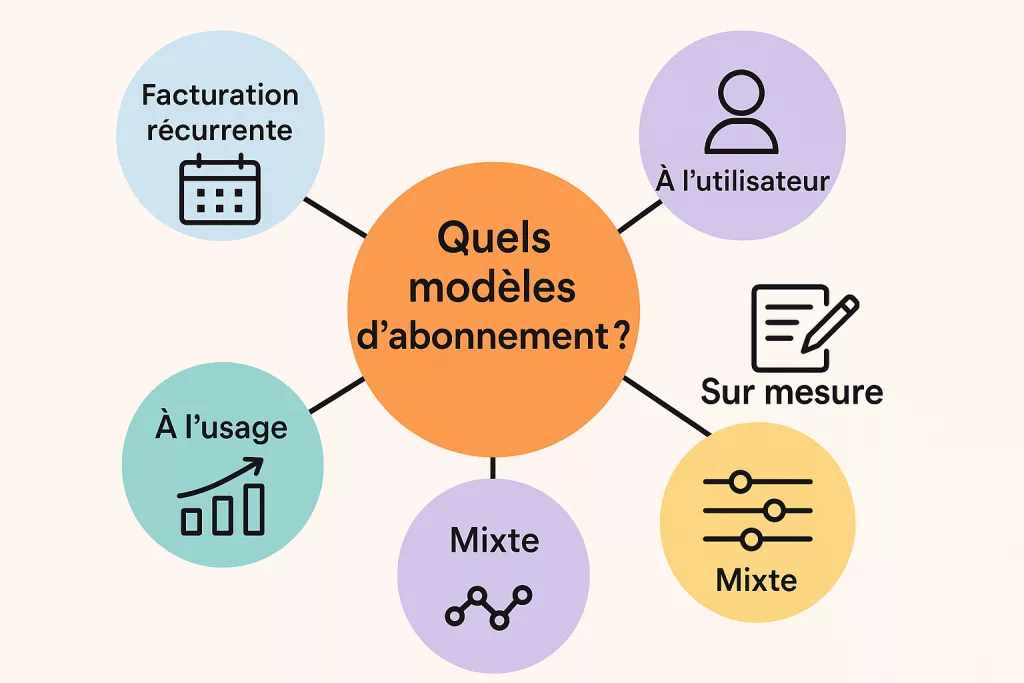
What are the possible subscription models?
There are several types of subscriptions that adapt to both the product or service offered and customer consumption habits.
Choosing the right model is a strategic decision: it directly determines revenue predictability, pricing flexibility, and the ability to build long-term customer loyalty. In retail as in B2B, each subscription structure responds to different consumption and logistics logic.
| Subscription Model | Principle | Advantages | Examples |
|---|---|---|---|
| Fixed recurring billing | Fixed price, billed on a recurring basis | Simplicity, revenue predictability | Gillette, Spotify |
| Per user | Billing based on number of users | Pricing clarity, scalability | Zendesk, Adobe Creative Suite |
| Usage-based | Variable rate based on consumption | Personalization, pricing fairness | Amazon Web Services, Fiat |
| Hybrid | Variable price depending on included services | Flexibility, sector adaptability | Gymlib, Hubspot |
| Quote to cash | Fully customized | Maximum flexibility, bespoke pricing | Enki Connected Home |
Subscription based on fixed recurring billing
Subscription based on fixed recurring billing is an ideal solution for companies offering a product or service at a fixed price, billed on a recurring basis.
It is perfectly suited to restocking everyday products, where the regularity of logistics flows and stock stability are key factors in customer satisfaction.
Key advantages:
- ✅ Most widespread model due to its implementation simplicity
- ✅ Easy integration into traditional business models (retail, e-commerce, distribution)
- ✅ High predictability of recurring revenue
- ✅ Simplified billing and financial flow management
Concrete examples:
Ideal for retail and restocking
This model is particularly effective for retail brands looking to transform a one-time purchase into a lasting business relationship. It reduces churn, stabilizes logistics flows, and improves inventory planning.
Per-user subscription
Per-user subscription bills the customer based on the number of users who access the service.
This model is perfectly suited to offers whose price varies according to the number of active users. It allows natural and transparent scaling: as the organization grows, billing adapts accordingly.
Many SaaS companies have adopted it successfully, notably Zendesk for customer relationship management and Adobe Creative Suite for creative tools in the enterprise.
Benefits:
- 📈 Excellent revenue predictability as the customer base develops
- 🔍 Great pricing clarity for the customer, who understands exactly what they're paying for
- 🔄 Natural scalability with customer growth (model scalability)
- 💼 Suited to B2B environments with variable team sizes
Caution regarding license capping
With this model, some customers may be tempted to share access to limit costs. It is recommended to contractually define usage conditions per user and implement digital control mechanisms to secure revenue.
Quick comparison: Fixed vs Per user
| Criteria | Fixed billing | Per user |
|---|---|---|
| Revenue predictability | ⭐⭐⭐⭐⭐ | ⭐⭐⭐⭐ |
| Customer flexibility | ⭐⭐ | ⭐⭐⭐⭐ |
| Management simplicity | ⭐⭐⭐⭐⭐ | ⭐⭐⭐ |
| Suited to growth | ⭐⭐⭐ | ⭐⭐⭐⭐⭐ |
| Ideal for | Retail, restocking, B2C | SaaS, B2B, teams |
Usage-Based Subscription?
Usage-based subscription is based on variable pricing: the company only charges for what the customer actually uses. This model breaks away from traditional flat-rate logic to adapt precisely to real consumption behaviors.
Key characteristics:
- Fair and transparent pricing
- Advanced personalization based on needs
- Custom pricing adapted to each profile
This system promotes advanced personalization and custom pricing, particularly suited to irregular or seasonal usage patterns. Amazon Web Services and Fiat are among the companies successfully leveraging this model at industrial scale.
Watch out for operational complexity
This model requires more sophisticated measurement and billing systems than fixed-price models. The digital infrastructure (data collection, real-time reporting, dynamic billing) must be robust to guarantee service reliability.
Hybrid Subscription
Hybrid subscription is a flexible subscription model, chosen by companies that want to offer a service whose price can vary depending on the services included. It combines the predictability of a fixed base with the flexibility of modular options.
Advanced features:
- Setup cost included in the subscription offer
- Ability to add e-shop products to the existing offer
- Adaptation to all business sectors (retail, logistics, B2B services)
Implementation examples:
- Gymlib gym membership subscription — monthly base + card access
- Hubspot CRM subscription — basic plan + additional modules on demand
Best practice for retail & logistics
The hybrid model is particularly effective in retail and logistics environments where inventory volumes and flows vary significantly depending on the period. It allows you to absorb activity peaks without renegotiating the entire contract.
The "Quote to Cash" Model
"Quote to cash," or fully custom subscription model, represents the most advanced level of personalization. It allows you to build a custom subscription offer from A to Z, from quote generation to payment collection.
The Quote-to-cash process enables complete personalization of a subscription offer, integrating each variable specific to the client: usage, volume, duration, possible recovery of existing equipment or reuse options.
Distinctive advantages:
- Maximum flexibility to adapt to each client context
- Compatibility with any product or service (physical or digital)
- Fully personalized pricing, without catalog constraints
- Custom solutions for specific needs, including second-hand or trade-in options
Concrete use case: The connected home automation solution Enki Connected Home launched by Leroy Merlin perfectly illustrates this model: a subscription offer built around a complex product ecosystem, with configurations varying according to each household's profile.
Comparative summary of the three models
| Model | Pricing | Flexibility | Technical Complexity | Ideal for |
|---|---|---|---|---|
| Usage-based | Variable by consumption | ⭐⭐⭐⭐⭐ | High | SaaS, cloud, mobility |
| Hybrid | Fixed base + options | ⭐⭐⭐⭐ | Medium | Retail, sports, CRM |
| Quote to cash | 100% custom | ⭐⭐⭐⭐⭐ | Very high | Complex B2B, home automation, logistics |
* Nasdaq, June 2020.
Want to go from theory to practice? Discover the retailers that chose ZIQY.
Request a demo →